Please don't read this blog if you may be upset or offended by discussion about the fate of the Grenfell Tower residents. This is my own personal opinion.
I'm sure, like me, you're well aware of the recent tragedy of the devastating fire at Grenfell Tower in London two weeks ago. I was shocked by the scenes which seemed impossible in a developed country, and have been incredulous at the inadequacy of the fire systems and flammable nature of the cladding and how that could have been allowed. Estimates today put the number of dead at 80, but from the start there has been strong wording that the real death toll may never be known, and some victims may never be identified.
It's fairly easy to realise that the poor people who were caught in the fire may be burned beyond recognition. Identification by sight may work for anybody overcome by fumes and smoke, but I'm guessing the fierceness of the fire will have mostly caused damage way beyond that. Those corpses will be fragile and probably difficult to safely move. This is often where dental identification comes in. Just yesterday I had an email alert from my indemnity society with a reminder about confidentiality of dental records and their release to police for assistance in identification, which I assume has been precipitated by a high number of requests following the tragedy. I've also heard that practices near Grenfell Tower have been asked to search their records by postcode.
I've had an interest in dental forensics for many years. Before I trained as a dentist I quite fancied the idea of being a pathologist, but realising it was a long route which first involved medicine I decided against it. At dental school we had several lectures about dental forensics, and the forensic department at Leeds was, I believe, very good. I particularly remember that they were involved in identifying a lot of the people who perished in the Bradford stadium fire in 1985, four years before I became a dental student. (As an aside, when I worked at Bradford St Luke's Hospital we shared a ward with the Plastic Surgery team, who had developed new techniques of treating extensive burns because of the number of victims from the incident. Advances in trauma management often happen as a result of large scale disasters or wars.) As well as identifying bodies forensic dentistry can be used in many ways. For example bite mark assessment can confirm and help convict an attacker, approximate age can be determined by dental development, and minerals taken into the teeth as they develop might indicate a country of residence. Dental identification helps in many cases where the victim can't be visually identified, for example extensive trauma to the face and head, burns, or prolonged submersion in water. I know a large team of dentists helped with identifying bodies after the Boxing Day tsunami in 2004.
So how do dental records help? If I am remembering correctly x-rays are usually taken before any more detailed examination. This is useful where bodies are fragile as they can be x-rayed without disturbing them too much. Then the mouth might be examined to check for the teeth present and any fillings, and any damage that might have occurred at the time of death or afterwards. X-rays and records can be compared to existing records to look for a match. Now, this is where it gets tricky because unlike a DNA or fingerprint database there is not a national dental records database. Dental records are held by the treating dentist, and not passed around with the patient like your GP records are. Some dentists still have paper records, though most will now have a computerised system. Even then x-rays don't really work like fingerprints, I'm not aware of a way of matching records or x-rays against a large database of people.
This means the best way to identify someone is to have an idea of their identity in the first place. Ask their dentist for their dental records, and then compare the records to the information you have. Occasionally the dental press send round a dental chart and an artist's impression of an unidentified body, but even if they have some quite unusual features this is quite a shot in the dark.
Cast your mind back to the Grenfell Tower residents. Some are known to be missing and their known flat and location found will help. Some may be in different flats, some may not have been expected to be there at all. Many are in social housing and low socioeconomic groups and some are refugees. How many of these are regular dental attenders? I suspect that many will not visit the dentist unless in pain, some may never have had dental care. NHS dental access is generally poor, I don't know the statistics for Kensington and the area around Grenfell, but across the UK the number of NHS dentists is falling and waiting lists are increasing. The residents are unlikely to have been in a position to pay for private care. Like much of the NHS, dentistry is underfunded and the system is broken. In some ways I feel that if there is money for the NHS is should be spent on hospitals, nurses and doctors, and NHS dentistry should be limited to urgent care in those that need it most and can't afford private care. Yes, I'd love NHS dentistry for all, but I realise the pot is limited, unless Theresa really HAS got a magic money tree.
So, if we have an idea who the potential victims are, we also need to know if they have seen a dentist and which dentist. We also need them to have had a dental charting, an x-ray (ideally several), and not have just attended for an emergency. We need the dentist in question to have accurately charted the teeth, kept the records and the x-rays safe, and be able to retrieve them. We have to keep records for 11 years, but if someone hasn't attended for a while they might be archived, in storage, and of course computer systems sometimes fail and paper records sometimes get lost or damaged.
Is it important we know who the victims are? Can't we just have a list of missing-presumed-dead? I'm sure friends and family need to know to be able to grieve. A death certificate is needed for the legalities to be able to be carried out after a death, insurance, financial settlements, inheritance, and later remarriage of the spouse. I also remember reading something about people taking advantage of a large-scale tragedy to disappear, something that is known to have happened after 9/11. So yes, I think it is important, and I know that many forensic dentists, pathologists and forensic scientists will have to deal for months to come with the grisly nature of the aftermath of the terrible fire. I don't apologise for the grim nature of this blog, I hope you have found it interesting and informative. Please join me in wishing strength to those dealing with loss and anyone in contact with them.

Wednesday, 28 June 2017


Wednesday, 19 October 2016
Can you tell someone's age by their teeth?

This question has been in the news today in relation to verifying the age of child migrants wanting to enter the UK. It has been suggested that their teeth should be examined to determine their age.
In my first year at dental school I was taught to identify different types of teeth and had to learn the ages that teeth came through into the mouth. In addition I had to learn the ages each tooth type started forming and the ages that the roots were fully formed, these can only be determined from an xray of the mouth. That was quite a lot of dates to learn! Once you know these you can determine the dental age of a patient from their mouth or an xray (an xray being more accurate as you have more information on unerupted teeth and the root development). This is possible because the order in which the teeth develop is fairly consistent.
Notice that I used the term 'dental age'. The dates that I learnt are based on averages. Much as the height or development of a child cannot tell you their exact age, dental age is the same. Dental age can be the same, more, or less than actual age. The main clinical purpose for its use is to monitor how the teeth develop and look for anomalies, for example teeth not appearing at the time they should. Alterations in the order that teeth develop is (to me as a clinician) more important than a difference between dental age and real age. Dental age is also used in forensics to help with determining age at time of death, but this would always be in conjunction with other data and could only give an approximation.
For example, the age that all the milk teeth are lost is 12 years old on average. A year or even two either way is not unusual, and I have seen it very between 9 and 15 years, that's quite a big difference! Once all the adult teeth are through it become more difficult to estimate dental age, and this might be done using an xray to look at development of the wisdom teeth if they are present, or looking at wear or dental damage. I'd expect someone with a poor quality of life living in a refugee camp to have poor dental health, which would cloud the issue. So using dental age on someone between the ages of 15-21 would be likely to be very inaccurate, this is just the age group that would need it most in this situation.
If dental age was to be used it might be necessary to take an xray to do so. However we have strict guidelines about the use of ionising radiation (of which xrays is one form) due to the risks to both individuals and the public in general. Xrays should only be taken when they are clinically necessary, that is they could alter how the treatment is carried out. Dental professionals have a responsibility to keep xray exposure 'as low as reasonably achievable'. Taking an xray purely for the purpose of determining dental age is therefore unethical and should not be done.
I do understand the need to try and determine someone's age to be able to help those genuinely in need, but dental age is not going to help in this situation.
Tuesday, 17 November 2015
Incognito Expert Forum, Nice

At the weekend I visited Nice, France for an expert forum on Incognito lingual braces. I've been using braces hidden behind the teeth for 9 years, and now use the Incognito brand almost exclusively for this type of treatment. Incognito braces are completely custom made to the specialist's prescription, leading to fantastic results and a great 'wearing experience' for the patient. This was a new meeting by invitation only, so I was delighted to be one of only 20 UK orthodontic specialists to attend, and the only one from Yorkshire. The meeting was held at the Hotel Negresco, a spectacular if rather unusually decorated hotel on the main Promenade des Anglais. Fortunately we had lovely weather, a complete contrast to Storm Abigail in the UK!

There were about 150 specialists, mainly from Europe, plus technicians from the German laboratory where they custom make each appliance. (Sadly some people hadn't made it due to the terror attacks in Paris affecting travel, more on that later.) The technology is incredible, Incognito started with 3D printing technology in 2001 when it was very new, and have continually developed the process and made it almost fully digital now. Many orthodontists are buying oral scanners which remove the need for taking impressions and sending by post. There were audible gasps of 'wow' in the audience as Incognito revealed the new digital light printer that can do the work of 40 of their previous printers. It's really useful to know what happens in the lab in between taking impressions and fitting the braces as it helps me to plan the treatment and understand what can and can't be achieved. I'm sure it's also useful for the technicians to see the clinical side and get to know the doctors.
Saturday afternoon was taken up with lectures by specialists from France, Japan, Italy, Scotland, Germany and the USA. The lectures including a lot of clinical tips, really helpful for not only planning treatment but also getting the best out of the braces to achieve the best results for my patients. There were some challenging cases treated to a very high standard. It was also great to chat to colleagues about lingual braces, and also about many other orthodontic topics, as well as having a social catchup with some friends I've met before.
Sunday was split into smaller groups leading to interesting and stimulating discussion. I gave a short presentation on providing temporary 'false' teeth to disguise gaps during treatment, and picked up some very useful tips and tricks from other specialists. It was inspiring to listen to others who use the appliance in many different situations, often in preference to other types of orthodontic brace. I can certainly recommend Incognito braces in confidencewith the knowledge it will deliver results as good as, or even better than traditional fixed braces on the front of the teeth.

Sunday afternoon was free so I walked along the prom to the old town. I had a good impression of Nice and would like to return and explore it more fully. It was really encouraging to see residents and tourists behaving normally after Friday's terrorist attacks in Paris, with many people and families out for a walk. In fact, the organisers and locals had been keen to stress that we were safe and still very welcome, and getting home via Nice airport presented no problems. Obviously our thoughts were very much with the French people and the Parisiens in particular.
I'd like to thank 3M Oral Care and Incognito for the invitation, and look forward to another meeting next year.
Tuesday, 24 February 2015
Why have orthodontic treatment?

You may think the answer to that question is easy, you have crooked teeth, so you need them straightening with orthodontic treatment. But why should we straighten teeth? This paper published in the current BDJ looks at the value of orthodontic treatment, and I found it a really interesting read.
I often quote the three main reasons for orthodontic treatment as dental health, dental function and aesthetics. For the majority of people with crooked teeth function (eating and speaking) is not a problem. Anyone with significant impairment, such as a lisp, is likely to find that orthodontic treatment alone won't solve the problem. Whilst patients tend to perceive that their teeth will be easier to clean and keep healthy when they are straighter, the evidence for straight teeth being healthier than crooked teeth is very poor. Leaving aside a few dental health issues such as buried teeth that only affect a few individuals, this leaves aesthetics as the prime reason for carrying out orthodontic treatment.
So why should the NHS continue to fund orthodontic treatment for children if it isn't going to bring an improvement in health? The paper states that about 10% of the NHS dental budget was spent on orthodontics in 2010-2011, amounting to £248m. That's a lot of money for something that could be considered cosmetic. Are patients being 'vain' when they seek dental treatment or is there more to it than that?
A different way of looking at this is to explore the effect of crooked teeth into psychological and social well-being, which this paper addresses. Psychological well-being could be considered the person's own view of themselves, but is affected by many things and the impact of a single factor like teeth is difficult to measure. Social well-being is how easily the person interacts with others, so this could include school, work, friends or significant others. The importance of these values and their measurement is a growing area, and patient reported outcome measures (PROMs) are becoming more widely used.
One paragraph in the conclusion really stood out for me. Many of my patients tell me how much happier they feel since having their teeth corrected, especially in meeting and interacting with people. The value of this cannot be underestimated, and confirms that although something might be considered to be an aesthetic problem, rather than a dental health problem, it isn't necessarily less important.
"The main value of orthodontic treatment is to allow individuals to cope more effectively in social situations, without concern for the appearance of their teeth. In a health service context this is wholly compatible with the WHO definition of health as 'a state of complete physical, mental and social well-being and not merely the absence of disease or infirmity'."
The NHS funds orthodontic treatment for children with severe enough problems (how severity is measured is a different subject)), and I do hope this continues to be the case, even though I don't personally have an NHS contract. But for adults or children that have milder problems orthodontic treatment can still bring a valuable change. So please don't think you are being vain in seeking treatment, if your teeth are affecting how you see yourself or how you interact with others it could have a greater effect on you than you think.
P. E. Benson,
H. Javidi
&
A. T. DiBiase
British Dental Journal 218, 185 - 190 (2015)
British Dental Journal 218, 185 - 190 (2015)
Wednesday, 4 February 2015
'Hello my name is...' and dental charges

On Monday on Radio 2 Jeremy Vine's lunchtime discussion programme had two topics that were particularly relevant. Firstly a discussion on dental charges and especially whether these should be displayed, and secondly doctor Kate Granger talking about her 'Hello my name is...' campaign. (You can listen to the discussions on iPlayer from half way through the programme.)
I always worry when I hear a dental topic is about to be discussed. A half hour slot which is mainly filled with music is not long enough to really understand the topic and the sides of the story, and dentists feel it's very easy to be misrepresented. Interestingly that isn't always the case, as the discussion about Desmond D'Mello late last year brought out many patients on his side.
Hello my name is...
This is an excellent campaign and so important, but I am really quite shocked that it is needed. As a junior dentist I spent several years work in hospital on wards and outpatients. I remember being dressed down by an anaesthetist for entering an operating theatre without introducing myself, and I used to introduce myself to my patients. However I do remember being confused as to the 'rank' of my colleagues, and this perhaps even less easy now as white coats have disappeared and uniforms become more casual.
It's very easy to forget that patients are often nervous or apprehensive and this is a special occasion for them. I think it's important that they are aware of someone's name but also their standing, is this the consultant, the junior doctor or the nurse, as you cannot tell by someone's gender or age.
I always introduce myself to my new patients and shake their hand, usually using my first name. They are often aware of who I am as my photo is on my website and practice literature, and of course they've booked to see me specifically, but I never assume. I expect my nurses to do the same and will always introduce anyone new in the surgery, for example when we have work experience students. Our staff are trained to answer the phone using their first name and everyone has name badges as well. It's a basic courtesy that should extend to most walks of life, not just doctors and hospitals. Perhaps people feels it's a bit 'American' to be introduced to their waitress, for example, but in a service industry it's a simple change that will improve the level of customer service, make the staff feel more valued and the clients more satisfied.
Dental Charges
Dental charges have been in the news recently with a Which? report slamming dentists for not displaying charges and allegedly overcharging. I say allegedly, as the data was gathered direct from patients without comparing to actual treatment provided. This was also based on NHS dental treatment.
NHS charges are set nationally, whereas dentists set their own private fees. I'm not going to go into the setting of NHS charges and dental contracts as it's a complicated topic. Whilst NHS fees are set, private charges will vary depending on the practice location and its overheads. (Immediately you wonder how practices with different demographics survive on the same NHS fees!)
As a practice owner I do believe that it is important for dentists to be clear about charges. However talking money is something that most dentists find very difficult. As a student I learned how to treat patients, and nothing about how to run a practice or how to discuss money with my patients. It can feel embarrassing to ask for large sums of money. I had to learn very quickly when I started my practice in 2005 as I did not have an NHS contract (a long story) and therefore all my patients were treated privately. If I'd undervalued my treatments or wasn't able to discuss money I'd have struggled to keep the practice running. At this stage I should thank the brilliant Ashley Latter, his training courses on communication are excellent and have shaped how I talk to my patients and carry out assessment visits.
At Wetherby Orthodontics we don't display fees outside the practice or even on the wall. We don't have public information posters on display. This was a concious decision to make the practice feel less like a hosptial and more like a boutique hotel or spa. However, fees are included in the welcome packs I send to all new patients. These are expressed as a range as I do not set fees for treatment until I have assessed the patient. At the first visit I will discuss fees face-to-face and also send a written treatment plan and estimate, including payment options. I know some dentist who still do not like discussing money, but delegate it to a treatment coordinator, which is an excellent solution. There's really no excuse for not being up front with your patients, after all if you buy clothes, a car, or a house the prices are usually easy to see.
I thought Jeremy Vine's programme did a reasonable job of getting the issues of dental charges across in a limited time. If you are a patient do make sure you understand what you are paying, when you are paying, and what it covers, no reasonable dentist will mind you asking and should be providing you with that information.
Saturday, 22 March 2014
I won!
Just a quick blog while I'm on the train home with an update from last night's Aesthetic Dentistry Awards.
I'm returning with rather more luggage than I arrived, as I am bring back four awards! This is my fourth time at these awards (they used to be called The Smile Awards) and after three Highly Commended certificates I really wanted a trophy.
I'm absolutely delighted to have been awarded all three of the orthodontic case prizes, for Removable braces, Fixed braces, and Invisalign. I was rather surprised to also win the overall prize for Best Aesthetic Dentist, as there were some stunning examples of treated cases there, everything from whitening to complex cases involving implants.
In fact it was a great night for our table, as my orthodontic friend Maria McNally won the Interdisciplinary prize, and Bilal Bhatti, another orthodontic friend, was awarded a Highly Commended certificate. How great to be taking certificates and trophies back to the North!
Over the next few weeks I'll publish the details of the winning cases with before and after pictures. In the meantime, I'm on my way to York for the British Lingual Orthodontic Spring meeting, which I have helped organise. I'm speaking in the afternoon too, what a busy weekend!
Tuesday, 14 January 2014
Favourites

I have a confession to make *takes deep breath*
I have favourite patients.
There, I said it. I don't mean in a Bruce Forsyth "You're my favourite" sort of way. I mean that I have patients I really love to treat. It's a bit like being a parent, you're not supposed to have favourite children, you're supposed to love them all equally. But sometimes you can't help preferring some more than others. (I have two children, who, usually, I wouldn't pick between, but occasionally I like one more!).
Perhaps I should point out that in terms of clinical treatment I try really hard to give everybody the same care. I do pride myself on my clinical results and really try to get the best result for everybody I treat. I know that my team are also very professional and will be consistent with our work procedures.
However, there are some patients I look forward to seeing, and often I find we spend longer chatting than we do treating. Seeing patients regularly, about every 7 or 8 weeks means I can really get to know them. We discuss things like Christmas, holidays and school exams, weddings, babies and school proms, triathlons, marathons and climbing, illness, travel and traffic jams, and even random things like bra sizes!
I was genuinely pleased to review a past patient yesterday who excitedly showed us her new engagement ring. I spent five minutes chatting about unwanted christmas presents with another. I was sad to say goodbye after a long but successful treatment to an incredibly nervous lady who had just adopted a child. I finished treatment for a lovely teen last week who brought me the homemade cake in the picture above (it was delicious!).
Now, if you're thinking about this you might have realised that I also have less favourite patients. I suppose there are a few, usually it's the ones who repeatedly break the braces and my heart sinks a little when I see their name in the diary! But there aren't very many, they still get treated (and a stern talking-to if their brushing remains poor or breakages are frequent), and there's always the next person to look forward to.
People often say to me "I don't know how you can look at teeth all day!" I do believe that the thing that makes dentistry interesting is the patients, not the teeth. Yes, there are interesting or challenging cases, but making the job interesting is more about engaging with my patients. To use a very worn cliche, it's about treating people, not patients.
Friday, 29 November 2013
Student memories

This rather ugly example of classic 1970's concrete architecture houses the Leeds Dental Institute (as well as the medical school and other related courses). Of course, when I started as an undergraduate dental student in 1989 it was two separate entities, the Dental School and the Dental Hospital.
It might not be the most attractive building but I have very fond memories of this place, having spent a significant amount of my adult life here. After as four years and one term as a dental student I worked for nine months as a house officer (this post no longer exists!), returned to do some weekly teaching in oral surgery 1997-1999, and became a full time student and specialist registrar in orthodontics from 2002 to 2005.
This year marks exactly 20 years since I graduated as a dentist. It's hard to believe I've really been a dentist for that long, but I've checked the maths, and can't find an error, so it must be true! The actual date I graduated is sometime in December, maybe the 11th, but my memory isn't *that* good!
Two weeks ago I returned to the Dental Institute take attend the Alumni Day, organised by the reformed Leeds Dental Alumni Association. There was a full day of lectures by past graduates or staff on a variety of topics, from current student teaching, to 3D technology and some of the latest dental politics. Sadly only a handful of my year could make it, but it was brilliant to see those that could. There were other familiar faces too, people from years who were there at the same time as me, and local dentists I have met or worked with over the years.
There was a lot of 'oh you haven't changed at all', which really was true, it was not difficult to recognise anybody! The same couldn't be said for the Dental Institute. Of course it has changed a lot in 20 years, but even in the 8 years since I was last there is looks and feels very different. I thought, perhaps for the benefit of past students, I'd run down the obvious changes.
Outside the building itself is much the same. The surroundings, however are very different. New buildings have sprung up, most notably the Jubilee Wing of the LGI and the multi-storey car park, but also the research building right next to the Worsley Building. Further away, if you take a short walk into Leeds you'd find Millennium Square, new shops and shopping centres, and loads of new bars and restaurants.
Enter the Worsley building on level 4 (this being the ground floor!) and the porter's desk is still there, but I wonder where all those cheerful porters, with their weekly 'buy a square' raffle went? The dental students are now clothed in maroon pyjamas, no own clothes any more, and no button-down-the-back tunics, it's more traditional front fastened ones now.
The dental common room on level 6 is still present, but smaller, the part that had the pool table is now a seminar room, and the pigeon holes orange seats are long gone (RIP). Even the lecture theatre has been refurbed (more than once I think), no orange there either, and of course proper digital projection, none of those slide carousels anymore. Which must mean less problem with upside-down or back-to-front slides, or dual projection getting out of sync!
I'll come back to the rest of the dental school in a bit. We were lucky to have a tour of the Dental Hospital. This was the bit that most astounded me. It had already been upgraded since I was an undergraduate (I remember Cons being refurbed while I was there, we thought it was state of the art then), but it's recently undergone a major transformation. So much that I got disorientated and couldn't really work out where I was! Walls have been moved, clinics combined (no separate Perio, Cons, Pros any more, but 'Restorative South' and 'Restorative North'), even Ortho has totally changed. However, it does look great, the digital radiography must be a real boon, but when will they get rid of those yellow note cards and go fully digital?
The biggest change is in the labs on the 5th floor. The phantom head room and the lab room where we spent hours sitting round benches with bunsens and wax knives are gone. Where 13 students used to crowding round one demonstrator, who tried to show us the finer points of drilling a cavity in a an extracted tooth technology has taken strides forward. The demo can now be seen 'as live' on a screen, and screen show in detail the student's work. The bit that impressed us all was the 'Simodont' room.

These make use of 3D and virtual reality technology, and can teach good posture while the student is learning, as you have to sit at the correct focal distance. A touchscreen selects the tooth you want to 'treat', and wearing 3D glasses, like those at the cinema, you can see it through the window. Select the instrument you want to use and you can not only see it in the window (this picture doesn't convey the 3D-ness of it all!) but feel like you're holding it in your hand. The foot pedal turns the drill 'on', complete with the appropriate noise, and when you 'drill' the tooth it looks and feels like real tooth. This is the really amazing bit, it really does feel just like drilling a tooth.


The student showing us round watched me, and commented that it was good to watch how a 'real dentist' drilled a tooth. Little did she know that I haven't removed any decay or done any fillings for 11 years since I started orthodontics full time!
Whilst this is still no substitute for real patients, with real teeth, tongues, lips and saliva, the students will be much better prepared when they do reach that stage. They need to be, with more student numbers than in my day (90 per year, we had about 50) there is less overall time for treatments, and 'totals' no longer exist. Sadly I missed the lecture on current student teaching as I was giving my own lecture to postgraduate orthodontists, but the staff did acknowledge that current students leave with less experience than we did (the people who qualified in 1973 probably said that about us). However the postgraduate training pathway is now more structured to take account of this.
In the evening there was a black tie dinner and disco, which was even better attended than the daytime. There were 7 of us in total from our year, we managed to find time to get a picture taken. From L-R Rav, Rachel, Rob, Bea, Me, Andy, Sarah.

The evening provided a less formal means of catching up with all the people I knew, and a few I didn't, plus some boogie-time on the dance floor. I did decline to join the more recent graduates at a nightclub in Leeds, with the excuse of not being able to walk in my heels.
Hopefully with the new committee in place and earlier notice we will get more of Year of 1993 along next year, or we'll be waiting for the next major milestone in four years time.
Tuesday, 29 October 2013
Submerging deciduous teeth and the value of x-rays

In dentistry and medicine we try hard to reduce the amount of x-ray radiation we use, it is a basic rule of radiation protection. This means we should only use x-rays when we really need to, when it could potentially alter our treatment. I take less radiographs now than I did when I qualified as an orthodontist. The standard I was taught as a dental student for orthodontic assessment was a panoramic (to show all the teeth) and an upper anterior occlusal (to check for supernumerary teeth and midline problems). As panoramic quality has improved the occlusal view is rarely needed, and I only take cephalographs in more severe cases now.
Sometimes there's a risk of not taking radiographs when we really need to, and there seems to be a real reluctance from some dentists to take radiographs on children, when they can help to manage a case.
The picture above is from an 11 year old boy I saw yesterday. His second deciduous molars are still present and are submerging quite significantly, being now below the contact points of the molar teeth and almost at gingival level. Having looked in the mouth I was certain that the premolar teeth must be missing, as is often seen when the deciduous molars submerge. A radiograph was indicated to confirm this before I decided on treatment.
Have a look at the radiograph and you can see that they are in fact all present and relatively well positioned. I have to admit to being rather surprised, but it does demonstrate that radiographs can be useful tools when correctly used.
Has it changed my management of the case? In the short term, no, as teeth submerged this far are best extracted anyway. But it does change my follow up of the case and the long term management (it also makes the IOTN 5s, so what appears to be a mild case now has a high need for treatment). I will need to make sure the space is maintained until the premolars erupt, I don't anticiapte any problems with this but I will review the patient regularly until the premolars erupt. If the premolars had been absent I'd have been more likely to allow some natural space closure before orthodontics (his anterior teeth are mildly crowded).
If you are a GDP please remember to monitor for submerging deciduous teeth, in this case the patient had been referred for another reason. If you are registered on Dentinal Tubules have a look at this thread which shows more severe sequalae for untreated submergence.
Tuesday, 9 April 2013
Don't believe the hype
A story in the dental press caught my attention today, quoting research from America that has shown that injections of dental anaesthetic in young children might stop wisdom teeth developing in the future.
Wow, that seems pretty amazing doesn't it? That a simple injection might stop the wisdom teeth developing, reducing the risks of pain, infection and surgical complications in the future. The authors seem pretty clear that the difference is significant, but I've never heard of anything like this before and I'm sceptical.
Now before I continue I should say that I haven't got access to the full article which I would need if I was going to do a full critique, but just reading through the reports it's pretty easy to pick out some flaws in the research.
The researchers looked back at records of children who had a dental x-ray at 7 years old or over and examined them to see if the wisdom teeth were developing. Already I'm a bit concerned as before the age of 10 the wisdom teeth are unlikely to appear and up until the age of 12 I wouldn't be confident that they were definitely missing.
Then they divided the children into two groups depending on whether they'd had a dental injection in the lower jaw between the ages of 2 and 6 and compared them to see which had the most wisdom teeth. I guess they could only know that if they'd had treatment at the same clinic. What if they'd had treatment elsewhere they didn't know about? Asking the patient or parent is not reliable either (though they don't appear to have done this).
The total number of patients was 220, giving 439 sites where wisdom teeth might develop, so that would be one on either side of the lower jaw for each patient (there's a missing one somehow!). 63 sites had received injections (comparison group) and 376 hadn't (control group), not very equal groups. Comparing 'sites' rather than 'patients' could confuse the results, as the left and right sides are not independant. So if the left wisdom tooth is missing it's more likely that the right one is too. Hopefully in the full results they explain if or how they've allowed for this.
This is the 'headline' though, "In the control group, 1.9% of the sites did not have X-ray evidence of wisdom tooth buds. In contrast, 7.9% of the sites in the comparison group – those who had received anaesthesia – did not have tooth buds. The comparison group was 4.35 times more likely to have missing wisdom tooth buds than the control group." They've applied some statistical analysis and found that this is significant, though I can't see what analysis they've used, if there was a sample size calculation or what level of significance, again I hope this is explained in more detail in the full paper. Looks pretty good though doesn't it, 4.35 times more likely to have a missing tooth if there's been an injection?
How about the numbers though? 1.9% is just 7 sites in the control group that didn't have a developing wisdom tooth. 7.9% of the comparison group is 5 sites. Remember that's 'sites' not 'patients', so this could represent as few as 4 and 3 patients! These numbers are pretty small and I'd say too small to make statistics meaningful, though I'm surprised it's not higher considering the age of the children when xrayed.
I don't think this is a good enough piece of research to change habits and make people start injecting small children in the hope their wisdom teeth might not develop. In any case, I'd like to see an argument that it's desirable have them missing, what happens if other teeth fail to develop or are lost through dental disease or trauma? But what it should do is stimulate more research. Larger groups and prospective trials or follow up studies would be better. I don't think the stats are good enough to support a study that would randomise to two groups, one with injections, one without, and long term monitoring with xrays though, as well as the eithical issues that would go with administering injections and xrays to children with no dental disease!
I think it's a good reminder that when we see a piece of research that tells us something we want to hear, or even something we don't (how often do we hear conflicting reports about whether wine or chocolate is good or bad for us) that there is often much more to it than that. A little probing into the facts and figures can often turn up flaws in the findings and we must be cautious not to believe the headline straight away.
Wow, that seems pretty amazing doesn't it? That a simple injection might stop the wisdom teeth developing, reducing the risks of pain, infection and surgical complications in the future. The authors seem pretty clear that the difference is significant, but I've never heard of anything like this before and I'm sceptical.
Now before I continue I should say that I haven't got access to the full article which I would need if I was going to do a full critique, but just reading through the reports it's pretty easy to pick out some flaws in the research.
The researchers looked back at records of children who had a dental x-ray at 7 years old or over and examined them to see if the wisdom teeth were developing. Already I'm a bit concerned as before the age of 10 the wisdom teeth are unlikely to appear and up until the age of 12 I wouldn't be confident that they were definitely missing.
Then they divided the children into two groups depending on whether they'd had a dental injection in the lower jaw between the ages of 2 and 6 and compared them to see which had the most wisdom teeth. I guess they could only know that if they'd had treatment at the same clinic. What if they'd had treatment elsewhere they didn't know about? Asking the patient or parent is not reliable either (though they don't appear to have done this).
The total number of patients was 220, giving 439 sites where wisdom teeth might develop, so that would be one on either side of the lower jaw for each patient (there's a missing one somehow!). 63 sites had received injections (comparison group) and 376 hadn't (control group), not very equal groups. Comparing 'sites' rather than 'patients' could confuse the results, as the left and right sides are not independant. So if the left wisdom tooth is missing it's more likely that the right one is too. Hopefully in the full results they explain if or how they've allowed for this.
This is the 'headline' though, "In the control group, 1.9% of the sites did not have X-ray evidence of wisdom tooth buds. In contrast, 7.9% of the sites in the comparison group – those who had received anaesthesia – did not have tooth buds. The comparison group was 4.35 times more likely to have missing wisdom tooth buds than the control group." They've applied some statistical analysis and found that this is significant, though I can't see what analysis they've used, if there was a sample size calculation or what level of significance, again I hope this is explained in more detail in the full paper. Looks pretty good though doesn't it, 4.35 times more likely to have a missing tooth if there's been an injection?
How about the numbers though? 1.9% is just 7 sites in the control group that didn't have a developing wisdom tooth. 7.9% of the comparison group is 5 sites. Remember that's 'sites' not 'patients', so this could represent as few as 4 and 3 patients! These numbers are pretty small and I'd say too small to make statistics meaningful, though I'm surprised it's not higher considering the age of the children when xrayed.
I don't think this is a good enough piece of research to change habits and make people start injecting small children in the hope their wisdom teeth might not develop. In any case, I'd like to see an argument that it's desirable have them missing, what happens if other teeth fail to develop or are lost through dental disease or trauma? But what it should do is stimulate more research. Larger groups and prospective trials or follow up studies would be better. I don't think the stats are good enough to support a study that would randomise to two groups, one with injections, one without, and long term monitoring with xrays though, as well as the eithical issues that would go with administering injections and xrays to children with no dental disease!
I think it's a good reminder that when we see a piece of research that tells us something we want to hear, or even something we don't (how often do we hear conflicting reports about whether wine or chocolate is good or bad for us) that there is often much more to it than that. A little probing into the facts and figures can often turn up flaws in the findings and we must be cautious not to believe the headline straight away.
Monday, 18 March 2013
Which brace is better?

On Saturday I attended the British Lingual Orthodontic Society (BLOS) spring meeting. (For those who don't know lingual orthodontics is the treatment of misplaced teeth using braces that are attached to the back of the teeth, rather than the front.) I am a committee member for BLOS and having helped with organising the meeting I'm pleased to say it was a really great day.
The meeting was fully subscribed showing a growing interest in lingual orthodontics in the UK (plus there were some European delegates). The venue was the Four Seasons Hotel at Canary Wharf, who were incredibly helpful and provided some amazing food during the breaks, especially the chocolate themed afternoon coffee break (yes dentists eat just as much chocolate as anyone else!).
This meeting brought together some of the best lingual orthodontists in the world, with practices in Paris, Berlin, Italy and Tel Aviv. Many of these ONLY use lingual braces! Each spoke about the lingual system of their choice with reasons why they preferred it over another. There were lots of clinical cases showing some fantastic treatment results and many happy patients. Each system has its own advantages and disadvantages, but there were a few things that really came over as a whole.
- Lingual orthodontics is in demand. The number of people wanting treatment that is rising and as orthodontists we need to be able to select braces that will get the result the patient wants as aesthetically as possible.
- If we, as orthodontists, do not get interested in lingual treatment we risk getting left behind. The UK may be behind other countries but we do follow the same trends eventually.
- Technology is becoming increasingly important. Most of the systems demonstrated used advanced Cad-Cam technology to plan and manufacture the braces. This makes it easier for the orthodontist to plan treatment, the patient to see the potential result, and gives greater accuracy of the braces and the final result.
Tuesday, 12 March 2013
Too Old for Braces?

Prospective clients often use the phrase 'at my age...' or 'I thought I was too old for braces'. So I thought I'd have a look at who my 'typical' adult patient is.
You might be surprised to hear that last year more than half (59%) of my patients were aged 17 or over. The proportion is growing each year, when I started the practice in 2006 adults made up about a third of my clients. I think this reflects both the growing demand for cosmetic dentistry and the availability of more aesthetic types of braces. It's probably not so surprising that women make up 70% of my clients, but the proportion of men seeking treatment is also growing.
The mean age of my adult clients when they started treatment was 38, but this doesn't really tell the full story. My oldest client was 66, with the biggest proportion being the 30-44 year olds, but nearly a third being aged 45 or over. There is no age limit to braces, though the treatment plan may need to be modified depending on missing teeth or dental disease, and sometimes combined with other dental treatment like whitening, crowns or implants.
.jpg)
The types of braces used also reflect the wish of adults to keep treatment as discreet as possible. For teenagers it's quite acceptable to wear metal fixed braces and they often decorate them with bright colours. Whilst a few adults will opt to have this type of treatment I usually use more aesthetic treatments instead. For many years aesthetic fixed braces were considered inferior but modern braces are virtually equivalent so I rarely offer standard metal braces to my adult clients.
The choice of braces is determined both by the problem and the type of tooth movement to be carried out, and the preference expressed by the patient. Standard, or labial fixed braces are attached to the front of the teeth, usually using ceramic brackets which blend fairly well with the teeth. This is the simplest treatment and is often chosen over other, less obviously visible brace types for reasons of time, cost and comfort, which is why it makes up half of the treatments I carry out. Clear aligners are mainly Invisalign, removable clear braces that are virtually invisible. Lingual fixed braces like Incognito are fixed to the back of the teeth so they can't be seen at all, they are perhaps less popular due to cost and worries about comfort, but it's probably the biggest growing area in orthodontics at the moment.

So
if you don't notice adults with braces every day, it's probably not because
adults don't have them - just that these invisible treatments are often very
hard to see!
The
truth is, I don't have a 'typical' adult patient. I treat people of all ages,
from all walks of life - some of whom travel quite a distance - for all sorts of
problems. And I'm happy to say I have a range of skills and treatments
available, so I can usually find a treatment to suit each person: it's all part
of your assessment, when we sit down together and chat about what
you'd like to do.
It's actually quite common for adults to take action to get the smile they
want. So if you'd like to pop in and see us, please do get
in touch.
Wednesday, 27 June 2012
Inspiring places, inspiring people
Every now and then there are a few days which make a difference. Over the last two weeks I've had several experiences I found inspiring.
I spent three days in the Lake District attending a course run by Ashley Latter. I've attended two of Ashley's courses before, so I knew it would be worth it. On the first day Ashley and some of the delegates met for a walk. We'd expected poor weather, as the last time we'd attempted this, but were blessed with warm, sunny and dry weather, and treated to a fantastic view from the top of Wansfell.
 The Lakes is a beautiful place, I love the unspoilt beauty of it and standing at the top of a fell after a hard walk up makes me glad to be alive and lucky to live in this amazing country. I think we all felt invoigorated afterwards, we certainly deserved our pint in the pub!
Ashley had worked really hard with orthodontist Richard Jones to present a programme we all learned from and enjoyed. Not about how to do orthodontics, but about how we can relate better with our customers and referring dentists whilst still running a successful business. The material was interesting and engaging and we've all come away with lots of ideas to put into practise. Ashley is not a dentist but really understands our businesses, and is one of those people you can't help but like.
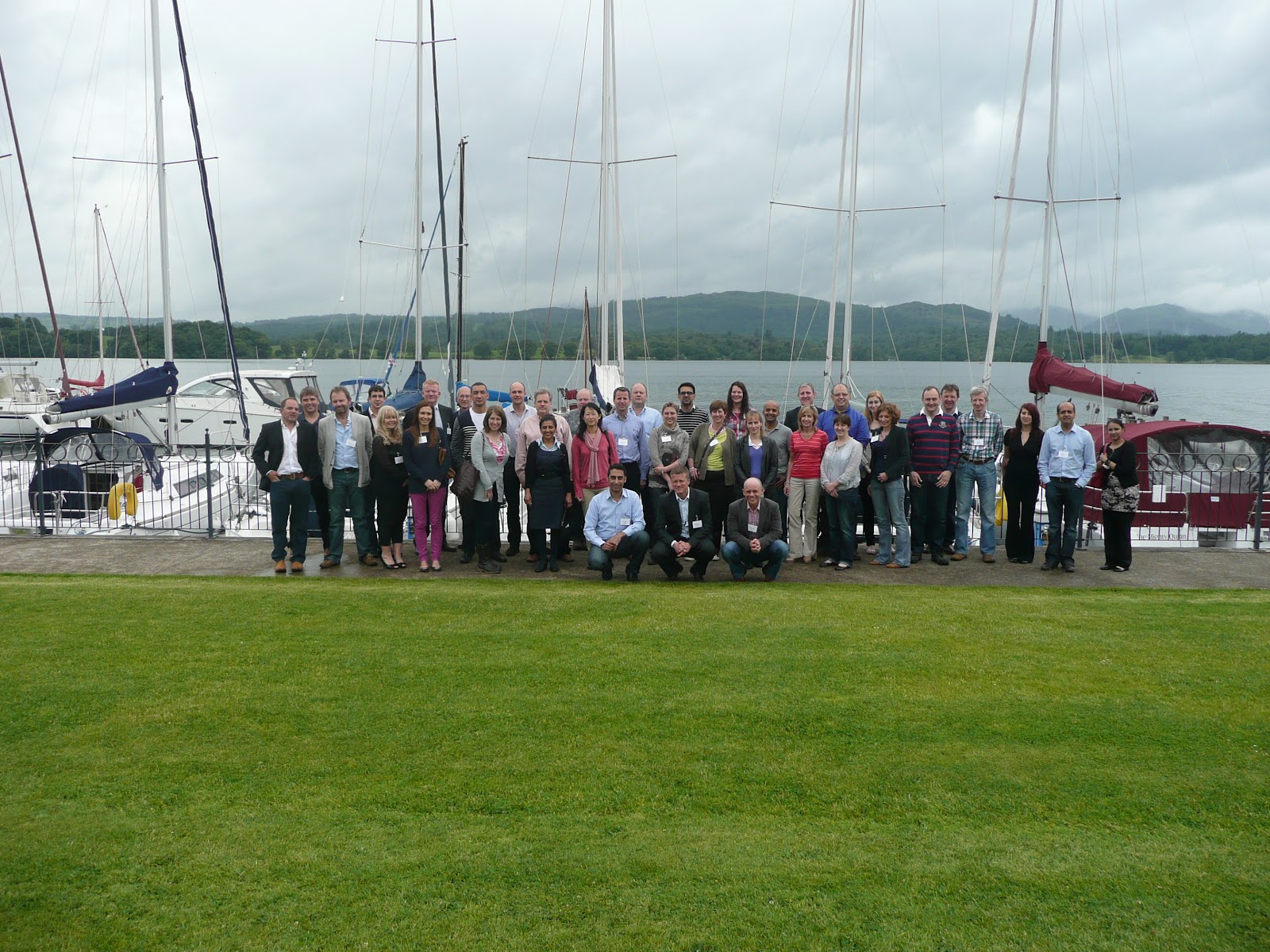
I have to also mention my fellow delegates, some of whom I had met before, but many I hadn't. Running a practice can sometimes be a bit lonely and isolated so the chance to talk and socialise with colleagues is brilliant, we all shared a similar vision and gave each other ideas. The orthodontists there came from a range of different types of practices, but I particularly want to mention Sheila Chauhan who has a practice like mine, of a similar age and size but located in Windsor. We managed to snatch some time where it wasn't raining to get a group picture by Lake Windermere. Some of us have already exchanged emails which is helping to keep me inspired and motivated and I hope we will continue to inspire each other.
 I can't write a blog on the subject of inspiration without mentioning the Olympic Torch relay. I took my children into Wetherby last Tuesday to see the torch coming through the town and I was delighted to see a great turnout in the town. We saw 13 year old George Stocker carrying the torch past us, he's a brain tumour survivor who has raised a lot of money for charity and is a bit of a local celebrity.

I should also mention some other torch bearers, including my friend Simon Buckden (who also proposed to his girlfriend as he carried the torch!), Ben Parkinson the severely injured soldier whose father built my dental cabinets, my friend's brother Dan Porter and the 13 year old Aaron Bell we saw light the cauldron at Temple Newsam on Sunday evening. The torch relay is full of people like this who have done amazing things like raising money or inspiring others, often whilst facing difficult times themselves. We can all learn not be be so self-centered and that whatever adversity we may face there are others having a harder time.
So this week I am concentrating on my long 'to-do' list after Ashley's course, remembering to count my blessings, and hoping that I can inspire others in some small way.
I spent three days in the Lake District attending a course run by Ashley Latter. I've attended two of Ashley's courses before, so I knew it would be worth it. On the first day Ashley and some of the delegates met for a walk. We'd expected poor weather, as the last time we'd attempted this, but were blessed with warm, sunny and dry weather, and treated to a fantastic view from the top of Wansfell.

Ashley had worked really hard with orthodontist Richard Jones to present a programme we all learned from and enjoyed. Not about how to do orthodontics, but about how we can relate better with our customers and referring dentists whilst still running a successful business. The material was interesting and engaging and we've all come away with lots of ideas to put into practise. Ashley is not a dentist but really understands our businesses, and is one of those people you can't help but like.
I have to also mention my fellow delegates, some of whom I had met before, but many I hadn't. Running a practice can sometimes be a bit lonely and isolated so the chance to talk and socialise with colleagues is brilliant, we all shared a similar vision and gave each other ideas. The orthodontists there came from a range of different types of practices, but I particularly want to mention Sheila Chauhan who has a practice like mine, of a similar age and size but located in Windsor. We managed to snatch some time where it wasn't raining to get a group picture by Lake Windermere. Some of us have already exchanged emails which is helping to keep me inspired and motivated and I hope we will continue to inspire each other.

I should also mention some other torch bearers, including my friend Simon Buckden (who also proposed to his girlfriend as he carried the torch!), Ben Parkinson the severely injured soldier whose father built my dental cabinets, my friend's brother Dan Porter and the 13 year old Aaron Bell we saw light the cauldron at Temple Newsam on Sunday evening. The torch relay is full of people like this who have done amazing things like raising money or inspiring others, often whilst facing difficult times themselves. We can all learn not be be so self-centered and that whatever adversity we may face there are others having a harder time.
So this week I am concentrating on my long 'to-do' list after Ashley's course, remembering to count my blessings, and hoping that I can inspire others in some small way.
Wednesday, 18 April 2012
How long will I wear my braces?

Of course I do try to estimate treatment time during the planning stages and be realistic about this, and in most cases I get it about right or slightly over-estimate. But it still doesn't stop the question being asked.
At the beginning of treatment teeth appear to move quickly. Towards the end of treatment the teeth can appear generally straight, and the changes will be mush smaller. Sometimes these can seem unnecessary to the patient, like getting that tooth 'just so' or trying to correct the bite. Patients often wonder why I'm spending time correcting something they are not concerned about.
Take the teenager I saw yesterday. His teeth look fabulous, they're straight and he's very happy with them. I'm concerned because the bite isn't correct, in his case the side teeth don't meet evenly and he doesn't have an obvious place to bite. I prescribed elastics to improve this, he'll need to wear them all the time to get the result, and this is the only thing that's left to correct, so if he wears the elastics well I'll be able to finish treatment in a few months. He wasn't exactly enamoured about wearing elastics, both for the appearance and the comfort of them and asked if he really needed them, after all, he's happy with the appearance now.
I find this a bit difficult as I think people perceive that I'm fiddling with the teeth for the sake of it and they won't get a real benefit, they'd rather finish treatment. It is certainly the detailing of the last few visits that makes a difference between a good result and a great result. Naturally I want to get the best result I can, at the end of the day I am the judge of my own treatments and I have high standards. But there's often more to it than that. Take the 'wrong bite' situation. Getting a good bite where the side teeth interlock nicely helps with long term stability, that's the teeth staying where I've put them. It prevents uneven wear on the teeth and puts less stress on the jaw joint and jaw muscles, which might cause problems later.
Will he wear his elastics enough? I'm not sure, but he's been informed why it's important and I hope he will successfully complete treatment. I really don't prescribe elastics (or any other form of treatment) for a joke, they are necessary in some cases, so please listen to your orthodontist and follow their advice, and ultimately, trust that all they are trying to do is get the best possible result. Isn't that worth a few extra months wearing braces?
Tuesday, 27 March 2012
Smile Awards 2012
The Smile Awards were held last week and for the third year in a row I'm delighted to have brought home a Highly Commended certificate, this time for 'Best Aesthetic Practice'.
Like many other industries and professions the dental industry has several awards ceremonies throughout the year, and dentists and practices are using these as a method of both team building within the practice and a way of promoting themselves to their clients. The other awards focus on things like marketing, teamwork or practice appearance, but the Smile Awards are the only ones to focus on clinical excellence. The categories cover the many ways of improving a patient's smile, whether this is through the use of white fillings, tooth whitening, crowns and implants or orthodontic treatment. Dentists submit photographs and a writeup of the case, which are judges anonymously by a panel of dentists and specialists.
The 'Best Aesthetic Practice' is a new category, to recognise a practice which provides aesthetic dentistry (which can encompass any type of dentistry which improves the appearance of someone's smile). I submitted a portfolio all about the practice, including photographs, testimonials, financial details, our branding and our staff.
The awards were held at the Landmark Hotel in Marylebone, London. I travelled down with Carly-Ann and Angela, its great to be able to dress up and enjoy a night out, we're more used to spending working time together. Here we are at the drinks reception.

The Landmark is a beautiful five-star hotel, with a large central atrium decorated with palm trees. It reminds me of a rhiad in Marrakesh, but on a much larger scale. The dinner was held in the grand ballroom and was delicious! Its always great to meet friends and colleagues and I'd arranged to sit with my friend and colleague John Scholey and his team, it was great to catch up and have a bit of banter!
After dinner the awards were announced, with the judges stressing the high standard of entries and how both the number and quality of entries had increased over the last few years. Sadly neither my fixed braces case nor my removable braces case picked up a prize in their categories. However John won the fixed braces and another orthodontist who qualified the same time as me, Darsh Patel, won the removable category. Although they showed before and after pictures on a large screen for all the shortlisted entries it wasn't possible to really tell why certain cases had won, but there were certainly some impressive smile transformations.
The last award to be announced was for Best Aesthetic Practice. Originally this was to be a regional award, but all nine practices were judged together. Having checked out the opposition beforehand (of course!) I really didn't think we had a chance in this, so it was a fantastic surprise to be announced as joint runner up and to be awarded Highly Commended along with a Harley Street practice, which shows a Yorkshire practice can really cut it with the big London practices!

Of course we had to have a little celebration...

The night didn't end there, Carly-Ann and Angela strutted their stuff on the dance floor and I enjoyed chatting with colleagues, some I'd met before and some I hadn't. It was great to finally meet some faces who I've been in touch with via Twitter, I'm pleased to say we got on just as well in real life as we do online! it was clear that everyone had real enthusiasm for their own branch of dentistry. We even got filmed for a promotional video, though I'll need to review it carefully before I post the link!
Back in Yorkshire I've had time to reflect and for this to really sink in. I've worked really hard over the last six years to make this practice a success. Many said it couldn't be done without an NHS contract. It has been tough at times, particularly when the recession hit as orthodontics is a 'luxury' item, but many dentists have found that cosmetic treatment is still a growing area, we all need to feel good after all.
I couldn't have done this alone, and I really have to say a big big 'Thank You' to my husband Jack Cooke and his business partner Richard Moon. Jack and I started on the road to our own practices when we bought the property in 2005, and I still share facilites and staff with their practice Ashby Dental. Their rebrand and redecoration last year prompted my own rebrand and together we've both introduced treatment coordinators (Carly-Ann and Angela) who've really helped to grow our businesses. At the risk of this becoming an Oscar acceptance speech I should also thank Chris Barrow for his business coaching excellence since 2005, all the dentists who refer patients to me, and my patients, especially those who recommend us to their friends. And of course my family, not just Jack but my children and my parents-in-law who often help out with childcare.
This isn't the end though, I plan to keep improving Wetherby Orthodontics and making many more patients happy with their new smiles. Its not all about awards, in fact my patients are far more important. I am confident of giving my patients great service and great treatment, awards are just an extra way of recognising this.
Wednesday, 14 March 2012
I hate dental impressions

If you've had orthodontics, a gumshield or bleaching tray made, or a crown you've probably had a dental impression. It seems to be one of the least liked dental procedures, and yet it is a very simple one that doesn't require drills, injections or anything else usually percieved as scary. My patients have at least two sets of these, one at the beginning and one at the end of treatment, the purpose being to take a copy or print of the teeth. This is cast in plaster in the laboratory so we have a permanent 3D record of the teeth and if needed braces can be custom-made.
Impressions are taken using a tray which fits over the teeth. This is filled with a substance called alginate which turns from jelly-like to a firmer rubbery consistency in a few minutes. Most people don't like the texture, but some people have a pronounced reaction which casues them to gag or feel sick if the impression material is near the back of the mouth. It is this and the lack of control over the situation that causes people to dislike impressions, or even have a phobia of them.
Luckily, taking impressions is relatively quick and there are things which both the dentist and the patient can do to make it a less fearful experience.
First of all, do tell your dentist that you are worried about the process or have had problems in the past as there are steps the dentist can take.
- Warm water. Mixing the alginate with warmer water makes it set quicker (remember your chemistry, heat speeds up chemical reactions)
- Thick mix. Mixing the alginate fairly thickly helps it set, stops it running backwards and is more comfortable to the patient.
- Less impression material. I make sure to avoid loading too much material into the tray, as long as it won't affect the quality of the impression I need.
- Talking! I talk to my patients while it is setting to distract them.
- Apron and bowl. I give my patients a bowl and tissues, its better for them to dribble into a bowl than to try to swallow! Its also reassuring for patients who think they might be sick that they have a bowl in front of them.
- Breathe! Don't forget to breathe, but it really helps to concentrate on breathing slowly and through your nose, not your mouth.
- Stay calm. Ok, easier said than done, but do try to stay as calm as possible.
- Dribble! See above, you will salivate a bit but its better to dribble than try to swallow.
- Sit forwards. I prefer to take my impressions with my patients seated upright, then ask them to tilt their head down so their chin is on their chest. Some dentists prefer to have the patient lying down, this can also work very well, even though it seems a little backwards!
- Distract yourself. Think about something completely different, wiggle your toes, sing a song or imagine you're on beach!
In 22 years of being a dental student and dentist I can only think of three times a patient has actually vomited during impressions, and those were when I had no warning of a possible problem. None of those have been since I'd had my own practice, I've taken thousands of impressions so I'm pretty good at it now. I always find its never as bad as people fear, think positively and you'll be amazed.
Thursday, 9 February 2012
Groupon? Not for me!

"Why?" you might cry, especially if you love Groupon or any of the similar discount voucher sites, in fact you may even have seen offers for for treatment such as tooth whitening or Invisalign.
I did write a really long blog post about the ethics of offering discounts on dental and medical treatment and why the figures don't stack up, and why it might work for businesses like restaurants and beauty salons where they can sell additional items or gain from repeat business.
I've deleted because I think the sort of clients I treat can see that and understand that and don't need it spelling out. There are certain brands you wouldn't expect to see on a discount site, like BMW or Porsche, Armani or Prada, The Ivy or The Manoir Aux Quat'Saisons. If these brands did start offering huge discounts it cheapens the brand, makes it less exclusive, just think what happened to Burberry a few years ago when the products suddenly became just that bit too popular.
So perhaps I'm going a bit far comparing myself to luxury brands, I certainly don't want to make myself and my treatments seem elitist, but much as some people will save up for that certain car, item of clothing or special meal many of my clients are seeing orthodontic treatment as an affordable luxury that will make them feel good about themselves. The true value is not in the cost but in how it makes you feel. Much as a Skoda will transport you, a coat from Primark will keep you warm, or a meal from Pizza Express will fill you up, that cheap braces offer may straighten your teeth, but will you get the same experience, the thing to treasure, to talk about, to make you feel good?
So, please don't ask me for special offers. I don't artificially inflate my prices so I can't offer discounts as this is a business and my livelihood, as well as my passion. I don't even mind if you 'window shop' a bit, by all means visit that practice offering a cheap deal, but come visit me too before you decide.
(If you still don't understand, read about the cupcake disaster, concerns from the ASA and OFT, the problems of time-limited medical offers and the General Dental Council's view of discount offers.)
Tuesday, 10 January 2012
New Year's Resolutions

Have you made a New Year's Resolution? The start of a new year always seems a good time to start or regain good habits. I'm sure many will have some sort of resolution to improve themselves, whether it be a diet, giving up smoking or being more organised.
I'm not one for resolutions myself, though I have promised myself I will spend more time doing the jobs I keep putting off as I'm an excellent procrastinator, so I suppose that's a sort of resolution!
How about a resolution that's easy to keep, will make you feel better about yourself, and will make other's feel better too? You might think that doesn't exist, but how about if you resolve to smile more? The simple act of smiling will instantly make you feel better and will make other people smile back. It's a universal language that you can use to communicate with anybody, friends, family or strangers. There's even research that suggests smiling will relieve stress, boost your immune system, lower your blood pressure and make you look younger. Have a look at this list of 10 reasons to smile.
*Edit* The same day I published this blog the Guardian wrote this article about how smiling is now fashionable! No longer do cover models on magazine's have sullen faces, they are showing their teeth in big smiles! Not just models, Kate Middleton is at it too (yes, her again!). I particularly like the final paragraph "Still, on the plus side, this is a fashion you can wear for free (memo: must book dentist appointment), and that suits me."
If you don't feel like smiling ask yourself why. Many of my clients tell me they always keep their lips closed when smiling, hide their mouth behind their hand and avoid being photographed. Are your teeth stopping you smiling? Perhaps 2012 is the year to do something about this?
Why not make your New Year's Resolution to find out what can be done to improve your smile? Simply call your dentist or orthodontist for a consultation. Many people think they are beyond help but there is always something that can be done and often it's not as difficult as you might think. If you're unsure about the difference orthodontics can make take a look at our 12 Smiles of Christmas to see some of our transformations over the last year. If you'd like a similar consultation please just get in touch and arrange a consultation or a complimentary visit with our treatment coordinator, and by New Year 2013 you could have a completely different smile!
Tuesday, 29 November 2011
The Duchess and the French orthodontist

I do think the Duchess has a lovely smile, I'm so pleased she hasn't gone down the route of porcelain veneers and instead chose orthodontics to help her, but I do have a few problems with the way this article portrays what she has had done. Let's leave aside for now the breach of patient confidentiality (it's NOT ok to tell your friends about your clients) and read between the lines of the article.
Harmonious asymmetry
I don't see much that's asymmetric about Kate's teeth. I'm sure if you used an accurate measuring device you'd be able to pick up small differences, but it's what the eye sees that counts. I'm not sure why an orthodontist would deliberately aim to leave asymmetry but there will always be some imperfections when the natural teeth are kept. The only way to get that perfectly even, perfectly white 'American' smile is with porcelain veneers, and even with that type of treatment a natural look can still be achieved if wished.
Micro-rotations
If something is 'micro' then are we able to detect it? I would never claim to be able to align teeth perfectly, I can get close to perfect, but perfect does not exist. There will always be 'micro-rotations' (see above!)
Lingual braces
There is little information to tell us what Kate actually had done to her teeth. This is not the first article to suggest she has had treatment by Dr Fillion, who could be called a dental pioneer in lingual braces. Lingual braces are like traditional fixed braces but attached to the back of the teeth (tongue side=lingual). Put them on the back and nobody can see them. Dr Fillion runs a respected course in lingual orthodontics in Paris and has developed his own system called Orapix. However, there are orthodontists all over the UK using lingual braces and it is growing in popularity amongst orthodontists and clients who'd like straighter teeth but prefer discreet braces.
I've been using the technique for five years and about 20% of my adult clients now choose lingual braces. As an orthodontist it is a challenging technique but I now feel comfortable using it and look forward to seeing my lingual clients. Almost anyone who is suitable for standard fixed braces is suitable for lingual braces, though they require a bit more time to get used to and cost more.
Take a look at the British Lingual Orthodontic Society website (you'll see Didier Fillion is the president) for more information and to find an orthodontist near you, or have a look at my own website. You don't need to be a princess or travel to London or Paris to get a smile like Kate's.
We may never know exactly what the Duchess has had done with her teeth but they do look lovely, straight yet natural. You can certainly be sure we will be seeing a lot more of her smile!
Wednesday, 26 October 2011
Some you lose
Its not often that I have a 'failure' to report, but one has happened this week.
A lady in her 60's asked me to improve her crooked lower teeth. Together we decided the best option would be to remove one lower front tooth to create space and fit a ceramic fixed brace to straighten the teeth and close the space. As with everyone I treat we discussed the possible problems she could face especially discomfort during treatment. Everyone will experience some level of discomfort, from either achy teeth or the braces rubbing on the inside of the lips, but this is usually temporary. For most people it takes 1-2 weeks to get used to wearing braces, but it does vary a lot.
Mrs H came to see me several times with areas of rubbing or soreness and in most cases I could help by suggesting orthodontic products or trimming sharp ends. However this week she has decided it is all too much and asked to have the braces removed. We discussed a few options but finishing treatment now was the final decision so she is now very relieved to be free of her braces, even though she does now have a small gap at the front.
Of course, I'm disappointed that it hasn't worked out for her, but this is only the second time in 6 years as an orthodontist that I have had to end treatment for these reasons. I think this shows that for most people the discomfort is temporary and can be tolerated for the end result. My mission is to make people happy, and if wearing braces is having the opposite effect then I'm not being very effective in my mission! I will always try and work with my patients for the best outcome, and this means taking every case separately and listening to their needs.
A lady in her 60's asked me to improve her crooked lower teeth. Together we decided the best option would be to remove one lower front tooth to create space and fit a ceramic fixed brace to straighten the teeth and close the space. As with everyone I treat we discussed the possible problems she could face especially discomfort during treatment. Everyone will experience some level of discomfort, from either achy teeth or the braces rubbing on the inside of the lips, but this is usually temporary. For most people it takes 1-2 weeks to get used to wearing braces, but it does vary a lot.
Mrs H came to see me several times with areas of rubbing or soreness and in most cases I could help by suggesting orthodontic products or trimming sharp ends. However this week she has decided it is all too much and asked to have the braces removed. We discussed a few options but finishing treatment now was the final decision so she is now very relieved to be free of her braces, even though she does now have a small gap at the front.
Of course, I'm disappointed that it hasn't worked out for her, but this is only the second time in 6 years as an orthodontist that I have had to end treatment for these reasons. I think this shows that for most people the discomfort is temporary and can be tolerated for the end result. My mission is to make people happy, and if wearing braces is having the opposite effect then I'm not being very effective in my mission! I will always try and work with my patients for the best outcome, and this means taking every case separately and listening to their needs.
Subscribe to:
Posts (Atom)