A story in the dental press caught my attention today, quoting research from America that has shown that injections of dental anaesthetic in young children might stop wisdom teeth developing in the future.
Wow, that seems pretty amazing doesn't it? That a simple injection might stop the wisdom teeth developing, reducing the risks of pain, infection and surgical complications in the future. The authors seem pretty clear that the difference is significant, but I've never heard of anything like this before and I'm sceptical.
Now before I continue I should say that I haven't got access to the full article which I would need if I was going to do a full critique, but just reading through the reports it's pretty easy to pick out some flaws in the research.
The researchers looked back at records of children who had a dental x-ray at 7 years old or over and examined them to see if the wisdom teeth were developing. Already I'm a bit concerned as before the age of 10 the wisdom teeth are unlikely to appear and up until the age of 12 I wouldn't be confident that they were definitely missing.
Then they divided the children into two groups depending on whether they'd had a dental injection in the lower jaw between the ages of 2 and 6 and compared them to see which had the most wisdom teeth. I guess they could only know that if they'd had treatment at the same clinic. What if they'd had treatment elsewhere they didn't know about? Asking the patient or parent is not reliable either (though they don't appear to have done this).
The total number of patients was 220, giving 439 sites where wisdom teeth might develop, so that would be one on either side of the lower jaw for each patient (there's a missing one somehow!). 63 sites had received injections (comparison group) and 376 hadn't (control group), not very equal groups. Comparing 'sites' rather than 'patients' could confuse the results, as the left and right sides are not independant. So if the left wisdom tooth is missing it's more likely that the right one is too. Hopefully in the full results they explain if or how they've allowed for this.
This is the 'headline' though, "In the control group, 1.9% of the sites did not have X-ray evidence of wisdom tooth buds. In contrast, 7.9% of the sites in the comparison group – those who had received anaesthesia – did not have tooth buds. The comparison group was 4.35 times more likely to have missing wisdom tooth buds than the control group." They've applied some statistical analysis and found that this is significant, though I can't see what analysis they've used, if there was a sample size calculation or what level of significance, again I hope this is explained in more detail in the full paper. Looks pretty good though doesn't it, 4.35 times more likely to have a missing tooth if there's been an injection?
How about the numbers though? 1.9% is just 7 sites in the control group that didn't have a developing wisdom tooth. 7.9% of the comparison group is 5 sites. Remember that's 'sites' not 'patients', so this could represent as few as 4 and 3 patients! These numbers are pretty small and I'd say too small to make statistics meaningful, though I'm surprised it's not higher considering the age of the children when xrayed.
I don't think this is a good enough piece of research to change habits and make people start injecting small children in the hope their wisdom teeth might not develop. In any case, I'd like to see an argument that it's desirable have them missing, what happens if other teeth fail to develop or are lost through dental disease or trauma? But what it should do is stimulate more research. Larger groups and prospective trials or follow up studies would be better. I don't think the stats are good enough to support a study that would randomise to two groups, one with injections, one without, and long term monitoring with xrays though, as well as the eithical issues that would go with administering injections and xrays to children with no dental disease!
I think it's a good reminder that when we see a piece of research that tells us something we want to hear, or even something we don't (how often do we hear conflicting reports about whether wine or chocolate is good or bad for us) that there is often much more to it than that. A little probing into the facts and figures can often turn up flaws in the findings and we must be cautious not to believe the headline straight away.

Tuesday, 9 April 2013


Monday, 18 March 2013
Which brace is better?

On Saturday I attended the British Lingual Orthodontic Society (BLOS) spring meeting. (For those who don't know lingual orthodontics is the treatment of misplaced teeth using braces that are attached to the back of the teeth, rather than the front.) I am a committee member for BLOS and having helped with organising the meeting I'm pleased to say it was a really great day.
The meeting was fully subscribed showing a growing interest in lingual orthodontics in the UK (plus there were some European delegates). The venue was the Four Seasons Hotel at Canary Wharf, who were incredibly helpful and provided some amazing food during the breaks, especially the chocolate themed afternoon coffee break (yes dentists eat just as much chocolate as anyone else!).
This meeting brought together some of the best lingual orthodontists in the world, with practices in Paris, Berlin, Italy and Tel Aviv. Many of these ONLY use lingual braces! Each spoke about the lingual system of their choice with reasons why they preferred it over another. There were lots of clinical cases showing some fantastic treatment results and many happy patients. Each system has its own advantages and disadvantages, but there were a few things that really came over as a whole.
- Lingual orthodontics is in demand. The number of people wanting treatment that is rising and as orthodontists we need to be able to select braces that will get the result the patient wants as aesthetically as possible.
- If we, as orthodontists, do not get interested in lingual treatment we risk getting left behind. The UK may be behind other countries but we do follow the same trends eventually.
- Technology is becoming increasingly important. Most of the systems demonstrated used advanced Cad-Cam technology to plan and manufacture the braces. This makes it easier for the orthodontist to plan treatment, the patient to see the potential result, and gives greater accuracy of the braces and the final result.
Tuesday, 12 March 2013
Too Old for Braces?

Prospective clients often use the phrase 'at my age...' or 'I thought I was too old for braces'. So I thought I'd have a look at who my 'typical' adult patient is.
You might be surprised to hear that last year more than half (59%) of my patients were aged 17 or over. The proportion is growing each year, when I started the practice in 2006 adults made up about a third of my clients. I think this reflects both the growing demand for cosmetic dentistry and the availability of more aesthetic types of braces. It's probably not so surprising that women make up 70% of my clients, but the proportion of men seeking treatment is also growing.
The mean age of my adult clients when they started treatment was 38, but this doesn't really tell the full story. My oldest client was 66, with the biggest proportion being the 30-44 year olds, but nearly a third being aged 45 or over. There is no age limit to braces, though the treatment plan may need to be modified depending on missing teeth or dental disease, and sometimes combined with other dental treatment like whitening, crowns or implants.
.jpg)
The types of braces used also reflect the wish of adults to keep treatment as discreet as possible. For teenagers it's quite acceptable to wear metal fixed braces and they often decorate them with bright colours. Whilst a few adults will opt to have this type of treatment I usually use more aesthetic treatments instead. For many years aesthetic fixed braces were considered inferior but modern braces are virtually equivalent so I rarely offer standard metal braces to my adult clients.
The choice of braces is determined both by the problem and the type of tooth movement to be carried out, and the preference expressed by the patient. Standard, or labial fixed braces are attached to the front of the teeth, usually using ceramic brackets which blend fairly well with the teeth. This is the simplest treatment and is often chosen over other, less obviously visible brace types for reasons of time, cost and comfort, which is why it makes up half of the treatments I carry out. Clear aligners are mainly Invisalign, removable clear braces that are virtually invisible. Lingual fixed braces like Incognito are fixed to the back of the teeth so they can't be seen at all, they are perhaps less popular due to cost and worries about comfort, but it's probably the biggest growing area in orthodontics at the moment.

So
if you don't notice adults with braces every day, it's probably not because
adults don't have them - just that these invisible treatments are often very
hard to see!
The
truth is, I don't have a 'typical' adult patient. I treat people of all ages,
from all walks of life - some of whom travel quite a distance - for all sorts of
problems. And I'm happy to say I have a range of skills and treatments
available, so I can usually find a treatment to suit each person: it's all part
of your assessment, when we sit down together and chat about what
you'd like to do.
It's actually quite common for adults to take action to get the smile they
want. So if you'd like to pop in and see us, please do get
in touch.
Wednesday, 27 June 2012
Inspiring places, inspiring people
Every now and then there are a few days which make a difference. Over the last two weeks I've had several experiences I found inspiring.
I spent three days in the Lake District attending a course run by Ashley Latter. I've attended two of Ashley's courses before, so I knew it would be worth it. On the first day Ashley and some of the delegates met for a walk. We'd expected poor weather, as the last time we'd attempted this, but were blessed with warm, sunny and dry weather, and treated to a fantastic view from the top of Wansfell.
 The Lakes is a beautiful place, I love the unspoilt beauty of it and standing at the top of a fell after a hard walk up makes me glad to be alive and lucky to live in this amazing country. I think we all felt invoigorated afterwards, we certainly deserved our pint in the pub!
Ashley had worked really hard with orthodontist Richard Jones to present a programme we all learned from and enjoyed. Not about how to do orthodontics, but about how we can relate better with our customers and referring dentists whilst still running a successful business. The material was interesting and engaging and we've all come away with lots of ideas to put into practise. Ashley is not a dentist but really understands our businesses, and is one of those people you can't help but like.
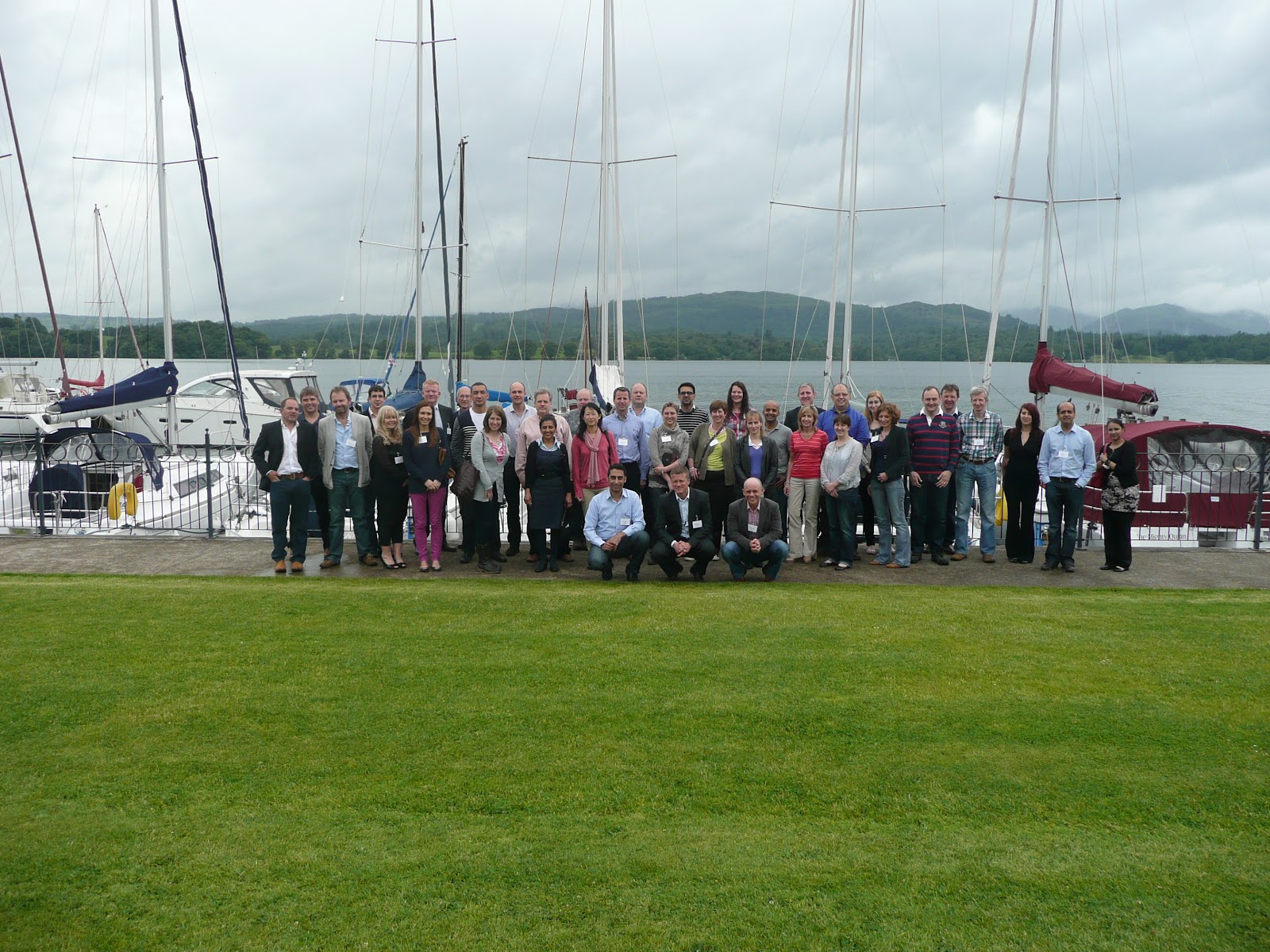
I have to also mention my fellow delegates, some of whom I had met before, but many I hadn't. Running a practice can sometimes be a bit lonely and isolated so the chance to talk and socialise with colleagues is brilliant, we all shared a similar vision and gave each other ideas. The orthodontists there came from a range of different types of practices, but I particularly want to mention Sheila Chauhan who has a practice like mine, of a similar age and size but located in Windsor. We managed to snatch some time where it wasn't raining to get a group picture by Lake Windermere. Some of us have already exchanged emails which is helping to keep me inspired and motivated and I hope we will continue to inspire each other.
 I can't write a blog on the subject of inspiration without mentioning the Olympic Torch relay. I took my children into Wetherby last Tuesday to see the torch coming through the town and I was delighted to see a great turnout in the town. We saw 13 year old George Stocker carrying the torch past us, he's a brain tumour survivor who has raised a lot of money for charity and is a bit of a local celebrity.

I should also mention some other torch bearers, including my friend Simon Buckden (who also proposed to his girlfriend as he carried the torch!), Ben Parkinson the severely injured soldier whose father built my dental cabinets, my friend's brother Dan Porter and the 13 year old Aaron Bell we saw light the cauldron at Temple Newsam on Sunday evening. The torch relay is full of people like this who have done amazing things like raising money or inspiring others, often whilst facing difficult times themselves. We can all learn not be be so self-centered and that whatever adversity we may face there are others having a harder time.
So this week I am concentrating on my long 'to-do' list after Ashley's course, remembering to count my blessings, and hoping that I can inspire others in some small way.
I spent three days in the Lake District attending a course run by Ashley Latter. I've attended two of Ashley's courses before, so I knew it would be worth it. On the first day Ashley and some of the delegates met for a walk. We'd expected poor weather, as the last time we'd attempted this, but were blessed with warm, sunny and dry weather, and treated to a fantastic view from the top of Wansfell.

Ashley had worked really hard with orthodontist Richard Jones to present a programme we all learned from and enjoyed. Not about how to do orthodontics, but about how we can relate better with our customers and referring dentists whilst still running a successful business. The material was interesting and engaging and we've all come away with lots of ideas to put into practise. Ashley is not a dentist but really understands our businesses, and is one of those people you can't help but like.
I have to also mention my fellow delegates, some of whom I had met before, but many I hadn't. Running a practice can sometimes be a bit lonely and isolated so the chance to talk and socialise with colleagues is brilliant, we all shared a similar vision and gave each other ideas. The orthodontists there came from a range of different types of practices, but I particularly want to mention Sheila Chauhan who has a practice like mine, of a similar age and size but located in Windsor. We managed to snatch some time where it wasn't raining to get a group picture by Lake Windermere. Some of us have already exchanged emails which is helping to keep me inspired and motivated and I hope we will continue to inspire each other.

I should also mention some other torch bearers, including my friend Simon Buckden (who also proposed to his girlfriend as he carried the torch!), Ben Parkinson the severely injured soldier whose father built my dental cabinets, my friend's brother Dan Porter and the 13 year old Aaron Bell we saw light the cauldron at Temple Newsam on Sunday evening. The torch relay is full of people like this who have done amazing things like raising money or inspiring others, often whilst facing difficult times themselves. We can all learn not be be so self-centered and that whatever adversity we may face there are others having a harder time.
So this week I am concentrating on my long 'to-do' list after Ashley's course, remembering to count my blessings, and hoping that I can inspire others in some small way.
Wednesday, 18 April 2012
How long will I wear my braces?

Of course I do try to estimate treatment time during the planning stages and be realistic about this, and in most cases I get it about right or slightly over-estimate. But it still doesn't stop the question being asked.
At the beginning of treatment teeth appear to move quickly. Towards the end of treatment the teeth can appear generally straight, and the changes will be mush smaller. Sometimes these can seem unnecessary to the patient, like getting that tooth 'just so' or trying to correct the bite. Patients often wonder why I'm spending time correcting something they are not concerned about.
Take the teenager I saw yesterday. His teeth look fabulous, they're straight and he's very happy with them. I'm concerned because the bite isn't correct, in his case the side teeth don't meet evenly and he doesn't have an obvious place to bite. I prescribed elastics to improve this, he'll need to wear them all the time to get the result, and this is the only thing that's left to correct, so if he wears the elastics well I'll be able to finish treatment in a few months. He wasn't exactly enamoured about wearing elastics, both for the appearance and the comfort of them and asked if he really needed them, after all, he's happy with the appearance now.
I find this a bit difficult as I think people perceive that I'm fiddling with the teeth for the sake of it and they won't get a real benefit, they'd rather finish treatment. It is certainly the detailing of the last few visits that makes a difference between a good result and a great result. Naturally I want to get the best result I can, at the end of the day I am the judge of my own treatments and I have high standards. But there's often more to it than that. Take the 'wrong bite' situation. Getting a good bite where the side teeth interlock nicely helps with long term stability, that's the teeth staying where I've put them. It prevents uneven wear on the teeth and puts less stress on the jaw joint and jaw muscles, which might cause problems later.
Will he wear his elastics enough? I'm not sure, but he's been informed why it's important and I hope he will successfully complete treatment. I really don't prescribe elastics (or any other form of treatment) for a joke, they are necessary in some cases, so please listen to your orthodontist and follow their advice, and ultimately, trust that all they are trying to do is get the best possible result. Isn't that worth a few extra months wearing braces?
Tuesday, 27 March 2012
Smile Awards 2012
The Smile Awards were held last week and for the third year in a row I'm delighted to have brought home a Highly Commended certificate, this time for 'Best Aesthetic Practice'.
Like many other industries and professions the dental industry has several awards ceremonies throughout the year, and dentists and practices are using these as a method of both team building within the practice and a way of promoting themselves to their clients. The other awards focus on things like marketing, teamwork or practice appearance, but the Smile Awards are the only ones to focus on clinical excellence. The categories cover the many ways of improving a patient's smile, whether this is through the use of white fillings, tooth whitening, crowns and implants or orthodontic treatment. Dentists submit photographs and a writeup of the case, which are judges anonymously by a panel of dentists and specialists.
The 'Best Aesthetic Practice' is a new category, to recognise a practice which provides aesthetic dentistry (which can encompass any type of dentistry which improves the appearance of someone's smile). I submitted a portfolio all about the practice, including photographs, testimonials, financial details, our branding and our staff.
The awards were held at the Landmark Hotel in Marylebone, London. I travelled down with Carly-Ann and Angela, its great to be able to dress up and enjoy a night out, we're more used to spending working time together. Here we are at the drinks reception.

The Landmark is a beautiful five-star hotel, with a large central atrium decorated with palm trees. It reminds me of a rhiad in Marrakesh, but on a much larger scale. The dinner was held in the grand ballroom and was delicious! Its always great to meet friends and colleagues and I'd arranged to sit with my friend and colleague John Scholey and his team, it was great to catch up and have a bit of banter!
After dinner the awards were announced, with the judges stressing the high standard of entries and how both the number and quality of entries had increased over the last few years. Sadly neither my fixed braces case nor my removable braces case picked up a prize in their categories. However John won the fixed braces and another orthodontist who qualified the same time as me, Darsh Patel, won the removable category. Although they showed before and after pictures on a large screen for all the shortlisted entries it wasn't possible to really tell why certain cases had won, but there were certainly some impressive smile transformations.
The last award to be announced was for Best Aesthetic Practice. Originally this was to be a regional award, but all nine practices were judged together. Having checked out the opposition beforehand (of course!) I really didn't think we had a chance in this, so it was a fantastic surprise to be announced as joint runner up and to be awarded Highly Commended along with a Harley Street practice, which shows a Yorkshire practice can really cut it with the big London practices!

Of course we had to have a little celebration...

The night didn't end there, Carly-Ann and Angela strutted their stuff on the dance floor and I enjoyed chatting with colleagues, some I'd met before and some I hadn't. It was great to finally meet some faces who I've been in touch with via Twitter, I'm pleased to say we got on just as well in real life as we do online! it was clear that everyone had real enthusiasm for their own branch of dentistry. We even got filmed for a promotional video, though I'll need to review it carefully before I post the link!
Back in Yorkshire I've had time to reflect and for this to really sink in. I've worked really hard over the last six years to make this practice a success. Many said it couldn't be done without an NHS contract. It has been tough at times, particularly when the recession hit as orthodontics is a 'luxury' item, but many dentists have found that cosmetic treatment is still a growing area, we all need to feel good after all.
I couldn't have done this alone, and I really have to say a big big 'Thank You' to my husband Jack Cooke and his business partner Richard Moon. Jack and I started on the road to our own practices when we bought the property in 2005, and I still share facilites and staff with their practice Ashby Dental. Their rebrand and redecoration last year prompted my own rebrand and together we've both introduced treatment coordinators (Carly-Ann and Angela) who've really helped to grow our businesses. At the risk of this becoming an Oscar acceptance speech I should also thank Chris Barrow for his business coaching excellence since 2005, all the dentists who refer patients to me, and my patients, especially those who recommend us to their friends. And of course my family, not just Jack but my children and my parents-in-law who often help out with childcare.
This isn't the end though, I plan to keep improving Wetherby Orthodontics and making many more patients happy with their new smiles. Its not all about awards, in fact my patients are far more important. I am confident of giving my patients great service and great treatment, awards are just an extra way of recognising this.
Wednesday, 14 March 2012
I hate dental impressions

If you've had orthodontics, a gumshield or bleaching tray made, or a crown you've probably had a dental impression. It seems to be one of the least liked dental procedures, and yet it is a very simple one that doesn't require drills, injections or anything else usually percieved as scary. My patients have at least two sets of these, one at the beginning and one at the end of treatment, the purpose being to take a copy or print of the teeth. This is cast in plaster in the laboratory so we have a permanent 3D record of the teeth and if needed braces can be custom-made.
Impressions are taken using a tray which fits over the teeth. This is filled with a substance called alginate which turns from jelly-like to a firmer rubbery consistency in a few minutes. Most people don't like the texture, but some people have a pronounced reaction which casues them to gag or feel sick if the impression material is near the back of the mouth. It is this and the lack of control over the situation that causes people to dislike impressions, or even have a phobia of them.
Luckily, taking impressions is relatively quick and there are things which both the dentist and the patient can do to make it a less fearful experience.
First of all, do tell your dentist that you are worried about the process or have had problems in the past as there are steps the dentist can take.
- Warm water. Mixing the alginate with warmer water makes it set quicker (remember your chemistry, heat speeds up chemical reactions)
- Thick mix. Mixing the alginate fairly thickly helps it set, stops it running backwards and is more comfortable to the patient.
- Less impression material. I make sure to avoid loading too much material into the tray, as long as it won't affect the quality of the impression I need.
- Talking! I talk to my patients while it is setting to distract them.
- Apron and bowl. I give my patients a bowl and tissues, its better for them to dribble into a bowl than to try to swallow! Its also reassuring for patients who think they might be sick that they have a bowl in front of them.
- Breathe! Don't forget to breathe, but it really helps to concentrate on breathing slowly and through your nose, not your mouth.
- Stay calm. Ok, easier said than done, but do try to stay as calm as possible.
- Dribble! See above, you will salivate a bit but its better to dribble than try to swallow.
- Sit forwards. I prefer to take my impressions with my patients seated upright, then ask them to tilt their head down so their chin is on their chest. Some dentists prefer to have the patient lying down, this can also work very well, even though it seems a little backwards!
- Distract yourself. Think about something completely different, wiggle your toes, sing a song or imagine you're on beach!
In 22 years of being a dental student and dentist I can only think of three times a patient has actually vomited during impressions, and those were when I had no warning of a possible problem. None of those have been since I'd had my own practice, I've taken thousands of impressions so I'm pretty good at it now. I always find its never as bad as people fear, think positively and you'll be amazed.
Subscribe to:
Posts (Atom)